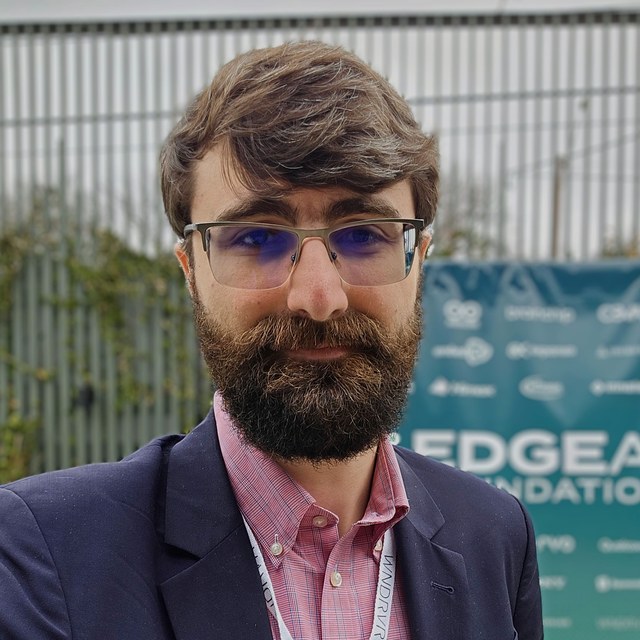
Petruț A. Bogdan
Neuromorphic Architect at Innatera Nanosystems · The Hague, Netherlands
Most people call me Peter.
I help write the architecture specifications for future generations of Innatera's brain-inspired chips. Most of that job is not silicon — it is keeping a clear line open between application engineers, software engineers and hardware designers, so that the chip we build is the one the applications actually need.
I also chair the Neuromorphic Working Group at the EDGE AI Foundation, where we try to give the field a common meeting point: industrial steering for the open neuromorphic community, a livestream programme, and use cases that show where this technology earns its keep today rather than in principle.
Before that, six years on SpiNNaker at the University of Manchester — a million-core neuromorphic machine — where I built the framework that lets simulated networks rewire themselves as they learn, and co-edited the book about it.
Areas I work in
Projects
-
Synfire Launched 2026
An open registry for neuromorphic models, launched by Innatera at Edge AI San Diego in March 2026. Models and whole processing pipelines are published in the NIR format with semantic versioning, model cards and hardware-aware metadata, reachable from the web, a CLI or a Python SDK, and targeting the platforms people actually build on — Loihi 2, Pulsar, SpiNNaker 2, BrainScaleS-2, Xylo.
Neuromorphic computing has no equivalent of the model hubs conventional machine learning takes for granted, and that fragmentation is a real barrier to the field scaling. NIR gave everyone a shared language; a registry builds the commons on top of it. I would very much like to see a large, flourishing space of neuromorphic models come into being — this is the part of that problem I can do something about.
-
Practical Spiking Neural Networks In progress
A free, community-written guide to designing, training and deploying spiking neural networks, co-edited with Ramashish Gaurav and Jens Egholm Pedersen. Written by more than ten contributors and released under CC BY 4.0, with the first chapters in early access.
The book I wanted when I started, and which still did not exist: theory tied to worked examples, aimed at practitioners rather than at the literature. I am also very lucky in my co-editors — Ramashish Gaurav and Jens Egholm Pedersen are both enormously energetic, and a project like this lives or dies on that.
Selected work
- 2025 The NeuroBench framework for benchmarking neuromorphic computing algorithms and systemsNature Communications 16:1545
- 2020 Boston–Delft: now publishersOpen access · over 100,000 downloads
- 2018 Structural plasticity on the SpiNNaker many-core neuromorphic systemFrontiers in Neuroscience 12:434
Background
- Oct 2021 – present
Neuromorphic Architect
Innatera Nanosystems — Rijswijk, NetherlandsI help create the architecture specifications for future generations of Innatera's brain-inspired chips. Doing that well is largely a communication problem: keeping a clear, continuous line open between application engineers, software engineers and the hardware designers, so the chip that gets built is the one the applications actually need.
- Apr – Oct 2021
Senior Neuromorphic Engineer
Innatera Nanosystems — Rijswijk, NetherlandsJoined Innatera from academia to work on bringing neuromorphic hardware to market.
- Oct 2019 – Apr 2021
Research Associate
The University of ManchesterImplemented a large-scale, biophysically representative model of the cerebellum on SpiNNaker with partners at the University of Pavia, working towards running it in real time. Much of that was diagnostic work on the machine itself: profiling the critical nodes being overrun with communication traffic, establishing how the mapping of neurons onto cores drives congestion, and determining the numerical precision needed for neurons receiving upwards of ten thousand connections, where unpredictable and potentially synchronised bursts of spiking all arrive at once.
- Jul – Oct 2019
Casual Software Developer
The University of Manchester (Huawei-funded)Converted artificial neural networks into spiking networks for SpiNNaker, and independently developed and tested gradient-free sparsification: online network compression by continuous rewiring, following Deep Rewiring (DEEP R), which trains networks down to 1% of their original connectivity. The same idea as my thesis, applied to conventional networks. Built with TensorFlow and Keras on NVIDIA Tesla V100s, and released openly.
keras_rewiring — Keras callback and sparse layers for online rewiring →
- 2016 – 2019
PhD, Computer Science
The University of ManchesterUnder Prof. Steve Furber, I built a C and Python framework that lets SpiNNaker simulate structural plasticity — networks that learn by rewiring which neurons connect to which, rather than only by adjusting the strength of connections that already exist. I used it to study topographic map formation, and applied synaptic rewiring to supervised and unsupervised learning tasks. Thesis awarded September 2019.
The SpiNNaker ecosystem, which I worked on from 2014 to 2021, received the 2026 Mahowald–Mead Prize for developing a large-scale neuromorphic computing platform that supports neuromorphic researchers and commercial applications. Mahowald–Mead Prize 2026 →
- 2014 – 2015
Summer researcher and verification engineer
SpiNNaker project, The University of ManchesterPython verification work on the SpiNNaker tool chain, then a Nengo-based spiking robot control system running on SpiNNaker, built with KTH Stockholm and a Swedish artist and exhibited at the Manchester Art Gallery.
- 2013 – 2016
BSc Computer Science, first class honours
The University of ManchesterThe degree covered computer engineering, digital signal processing, embedded programming, and both symbolic and sub-symbolic AI and machine learning. For my final-year project I built a spiking-neuron robot control system and a vision system modelled on the mammalian visual cortex, exhibited at the Manchester Art Gallery.
Recognition
- 2025
Named in the fifth annual list, which recognises technology executives who have been featured speakers at Parks Associates' executive conferences.
- 2016 President's Doctoral Scholarship Award
Awarded to PhD students whose research has the potential for significant societal impact.
Evaluation & review
- Aug 2025 – present
Juror and evaluator, grant proposals
FFG — Austrian Research Promotion AgencyServing on evaluation juries for national research and innovation funding proposals, across two consecutive years.
- ongoing
Peer review
Journals and conferencesMore than 50 verified peer reviews, for journals including Nature Communications, Frontiers in Neuroinformatics and Cluster Computing.
- 2023 – 2025
Technical programme committee
tinyML and EDGE AI Foundation symposiaTPC member for the tinyML EMEA Innovation Forum (Amsterdam, June 2023), where I led the organisation of the benchmarking panel; the tinyML Research Symposium (San Francisco, 2024); and the 5th International Research Symposium (Austin, February 2025).
Community & service
- Dec 2024 – present
Chair, Neuromorphic Working Group
EDGE AI FoundationInvited to co-chair alongside Charlotte Frenkel, and sole chair since August 2025. The group is a meeting point for neuromorphic work across industry and academia: benchmarking and NeuroBench, models, software frameworks, hardware, and the job of mapping neuromorphic capability onto real industry verticals. I built the membership through 2025, ran a workshop at EDGE AI Milano in July 2025, held the kick-off that September, and organised the first online neuromorphic mini conference.
- Nov 2025
Delegate, Future of Compute innovation mission to the UK
Netherlands Enterprise Agency (RVO) and the Dutch Embassy in LondonPart of the neuromorphic track of a Dutch mission on energy-efficient computing, including the Future of Compute symposium at the Royal Society and the UK–NL Neuromorphic Computing Ecosystem meeting at the Netherlands Embassy. I stayed on for the bilateral NL–UK neuromorphic network that came out of it, contributing to its strategic roadmap and action-line working groups.
- 2026
Speaker, contributor and advisory board
EDGE AI FoundationSpeaker at EDGE AI San Diego, contributor at EDGE AI London, and a member of the Strategic Partner Advisory Board.
- Apr 2017 – Apr 2021
Student Ambassador, Neuromorphic Computing
Human Brain ProjectRepresented students across the HBP's neuromorphic computing sub-project and helped run the HBP Tea & Slides mini-seminar series.
- 2018, 2019, 2021
Programme committee
2nd, 3rd and 5th HBP Student ConferencesInvited speakers, reviewed abstracts, and chaired sessions on the day. The 5th was the first to run entirely online.
- 2017
Steering committee
2nd HBP Young Researchers EventIdentified and invited tutorial developers, and tutored participants on using SpiNNaker.